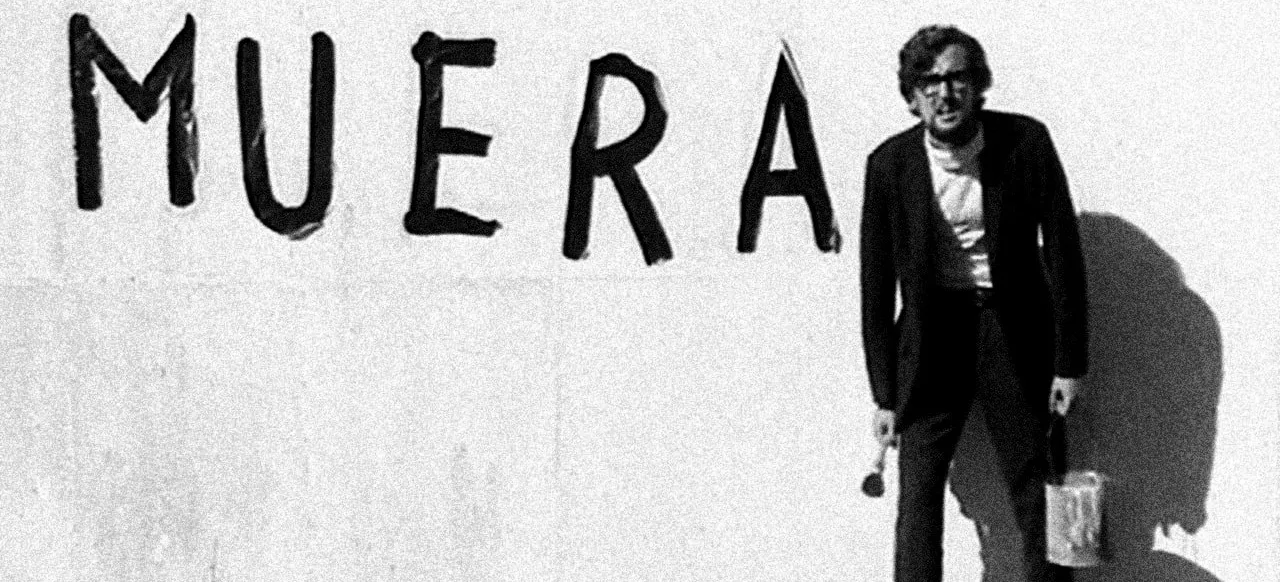
Apuntes sobre la tortura y otras formas de diálogo (Notes on Torture and Other Forms of Dialogue, 1968) is a short fiction film that Patricio Guzmán made as a second-year exercise at the Official School of Cinematography in Madrid, in collaboration with the Chilean playwright Jorge Díaz. It is a satire of military repression in Latin America and of a left that talks a lot and does little. It runs 15 minutes.
About the film
Guzmán studied at the Madrid film school in the late 1960s. This short was the start of his collaboration with Jorge Díaz, a playwright known for his acid humor and one of the driving forces behind the ICTUS theater group in Santiago; together they would also make El paraíso ortopédico (1969).
It opens like a television commercial offering torture instruments in models for every region of the world; the Latin American one is called the “Punta del Este Model.” Then soldiers chase a man across a plain, capture him and torture him in front of a commander, while a group of left-wing intellectuals, surrounded by books, condemn torture without ever going beyond words. In one scene, a man shouts at the camera, which is filming him from a helicopter: “Come down from the clouds.”
Toward the end come newsreels about the death of Che Guevara in Bolivia, the sentencing of Régis Debray and the death of the priest Camilo Torres. For Jorge Ruffinelli, Guzmán’s biographer, it is this news footage, and not the fiction, that the filmmaker would go on to develop. The last image is the prisoner’s gaze, fixed on the viewer.
Reception
For decades the film was talked about far more than it was seen. In October 2020 the Filmoteca Española streamed it online for a week, and the critic Roger Koza called it an “archaeological find,” remarkable for something rare in Guzmán’s cinema: humor. Some filmographies list it as La tortura y otras formas de diálogo.
Sources
- Filmoteca Española
- Con los ojos abiertos
- Jorge Ruffinelli, Patricio Guzmán, Cátedra / Filmoteca Española, 2001
- Roger Koza, Con los ojos abiertos, October 17, 2020