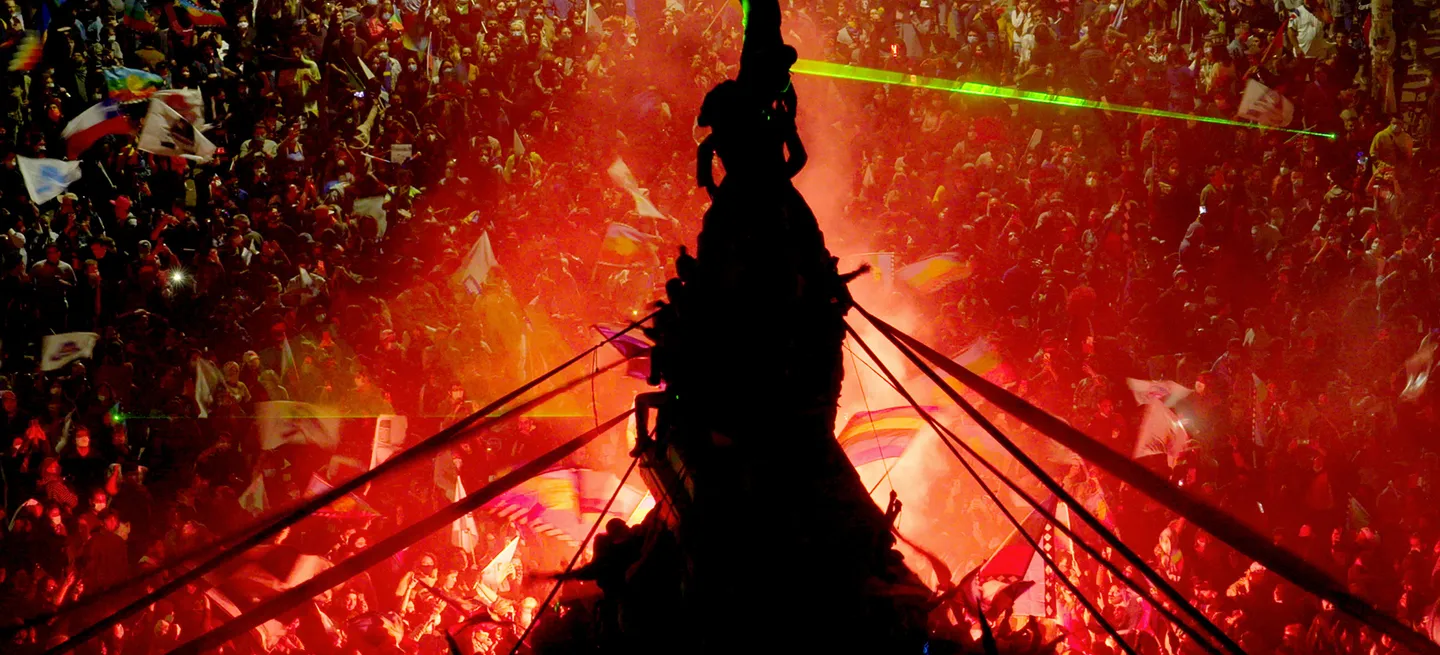
My Imaginary Country (2022) is Patricio Guzmán’s documentary about the social uprising that began in Chile in October 2019 and led to the process of drafting a new constitution. It premiered on May 20, 2022, in the Special Screenings of the Cannes Film Festival and reached Chilean theaters on August 11, 2022, Guzmán’s 81st birthday. It runs 83 minutes.
- 7.1IMDb · 666 votes
- 3.7Letterboxd · out of 5
- 6.7FilmAffinity · 179 votes
- 94 %Rotten Tomatoes · 33 reviews
Data as of November 23, 2026.
About the film
In October 2019, as The Cordillera of Dreams was opening in France, something Guzmán did not expect happened in Chile. Student protests against a rise in subway fares turned into a revolt: a million and a half people took to the streets of Santiago to demand more democracy, a more dignified life, better education and health care, and a new constitution.
“Chile had recovered its memory,” Guzmán wrote. “The event I had been waiting for since my student struggles in 1973 finally materialized.” And also: “Since Allende, I had never seen anything like it.”
His previous film ended with a wish: that Chile would recover its childhood and its joy. My Imaginary Country begins where that wish seems to come true.
Guzmán narrates the beginning and the end; in between, the film follows the marches by day and by night, the clashes with the police and the painted walls. “Many people lost an eye. Thousands were injured,” Guzmán recalls.
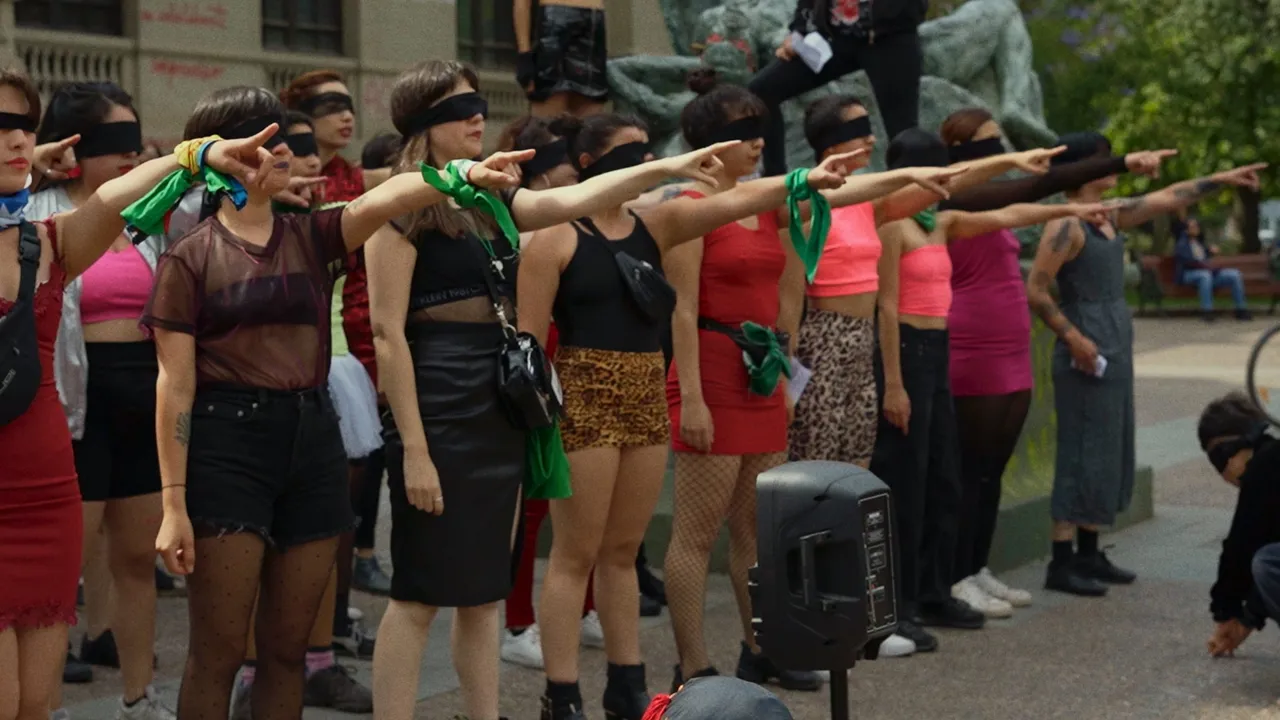
All the voices in the film are women’s: the journalist Mónica González, the political scientist Claudia Heiss, the writer and actress Nona Fernández, the Mapuche constitutional delegate Elisa Loncón, the collective Las Tesis and a member of the so-called “front line,” among others. They talk about what they did in the streets and what they hoped to do.
The film follows the process up to the October 2020 referendum, in which nearly 80 percent voted for a new constitution, and up to Gabriel Boric’s election in December 2021. “An unprecedented event in the country’s history, my imaginary country,” Guzmán says.
Making of
Guzmán could not travel to Chile right away, and then the pandemic delayed the shoot. From France, he asked three or four friends in Santiago to film the streets. “Film this, film that, I want it in the morning, I want it in the afternoon,” he recalled in an interview. With that footage he made a first cut that helped him secure funding, and then he traveled with his crew to do the interviews and film the referendum.
At first he filmed men and women, but he was struck by how the women analyzed what was happening with more clarity and spontaneity. “In the end we decided to edit only the women, and we don’t regret it,” he said.
Samuel Lahu shot the film, Laurence Manheimer edited it, and the music is by José Miguel Miranda and José Miguel Tobar. It was produced by Atacama Productions, Arte France Cinéma and Market Chile.
Reception
The film received a long ovation at Cannes; according to Guzmán, the audience applauded for more than twelve minutes. In Chile it opened to full houses, and in Valparaíso the screening ended with the audience singing “Happy Birthday” to him.
In North America, Icarus Films opened it at the IFC Center in New York on September 23, 2022. In The Guardian (June 6, 2023), Peter Bradshaw called it a “staggering documentary.” In CIPER (August 11, 2022), Jorge Letelier praised it for recalling the power of the majority that took to the streets, but faulted its romantic view, which overlooks the contradictions and tensions that followed the uprising, such as the violence and the damage to public spaces.
Sources
- CineChile
- Festival de Cannes
- CIPER
- El Mostrador, May 20 and August 12, 2022
- Gabriela Bravo, interview with Patricio Guzmán, Culturizarte, August 9, 2022
- Screen Daily, “My Imaginary Country goes to Icarus for North America,” 2022
- Peter Bradshaw, The Guardian, June 6, 2023