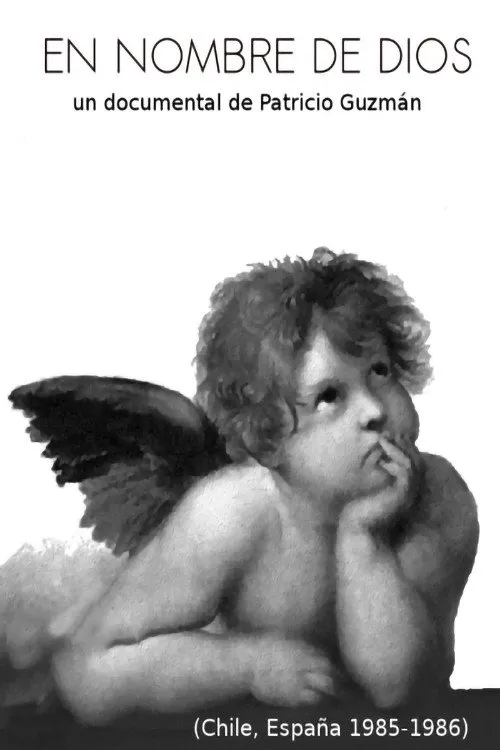
In the Name of God (1987) is Patricio Guzmán’s documentary about the Chilean Catholic Church under Augusto Pinochet’s dictatorship. It shows the work of the Vicariate of Solidarity, which defended prisoners and searched for the disappeared, and the large protests of the mid-1980s. A coproduction with Spanish Television (TVE), it runs 97 minutes.
About the film
Unlike what had happened in Spain, Guzmán wrote, the Chilean Church took a stand against the dictatorship from the very first day. Cardinal Raúl Silva Henríquez created the Vicariate of Solidarity, a human rights office with lawyers, social workers, doctors and psychologists who defended prisoners in court and searched for the disappeared.
The film brings together interviews with priests, bishops and theologians who say bluntly that those governing the country are not Christians, because of the crimes they commit. Alongside them are the 1985 protests in the poor neighborhoods, the universities, the unions and downtown Santiago, and the repression that followed: police charges, arrests, water cannon trucks.
One of the most powerful moments involves the Sebastián Acevedo movement, named after a man who set himself on fire to protest against the dictatorship. Its members sang outside the headquarters of the secret police or the Ministry of Defense and waited for the police without moving, without stopping their song, enduring the blows and the arrests.
In Variety, Hans Ehrmann described it as a lively, technically solid look at a complex subject. The film also opened a path: his interest in the role of faith in Latin American history led Guzmán to The Southern Cross (1992).
Making of
It was the first time Guzmán had returned to Chile since the 1973 coup. He entered on his Spanish passport and spent about three months in Santiago, helped by a group of young local filmmakers, among them Pablo Salas, Hernán Castro and Germán Malig, who filmed much of the street clashes. Jaime Reyes shot the film, Luciano Berriatúa edited it and José Antonio Quintano wrote the music; it was produced by Santiago Cinematográfica, the company of Arturo Feliú and Guzmán himself, and TVE.
The shoot ended abruptly. At the end, the police arrested two members of the crew, the sound engineer Pablo Basulto and the assistant director Hernán Castro, who spent several weeks in prison. Guzmán edited the film in Madrid.
Reception
It won the Grand Prize of the Festival dei Popoli in Florence and the second documentary prize at the Havana festival in 1987. At the 1988 Berlinale it received the OCIC award and the Peace Prize, and that same year the Glauber Rocha Award in Figueira da Foz, Portugal.
In El País, Ángel Fernández Santos reported that the film had drawn “one of the loudest ovations” of the festival. The Florence jury noted that, “made in extremely dramatic circumstances,” the film showed in an unprecedented way a Church at the forefront of the fight against the dictatorship. Today it is regarded as the best-known work of the years Guzmán spent in Spain.
Awards
- 1987Festival dei Popoli, Florence — Grand Prize
- 1987Havana Film Festival — Second Documentary Prize
- 1988Berlinale — OCIC Award
- 1988Berlinale — Peace Prize
- 1988Figueira da Foz Film Festival — Glauber Rocha Award
Sources
- CineChile
- Patricio Guzmán, official website
- Revista Primer Plano
- Patricio Guzmán, director’s notes, official website (2017 version)
- Pedro Sorela, El País, September 18, 1986
- Ángel Fernández Santos, El País, December 17, 1987 (quoted on the official website)
- Hans Ehrmann, Variety, April 18, 1987 (Spanish translation on the official website)
- Oggi Toscana, December 13, 1987 (Festival dei Popoli jury statement, quoted on the official website)
- Film page, IDFA archive
- Ignacio del Valle-Dávila, “Patricio Guzmán: el país de la memoria,” Primer Plano, September 24, 2026