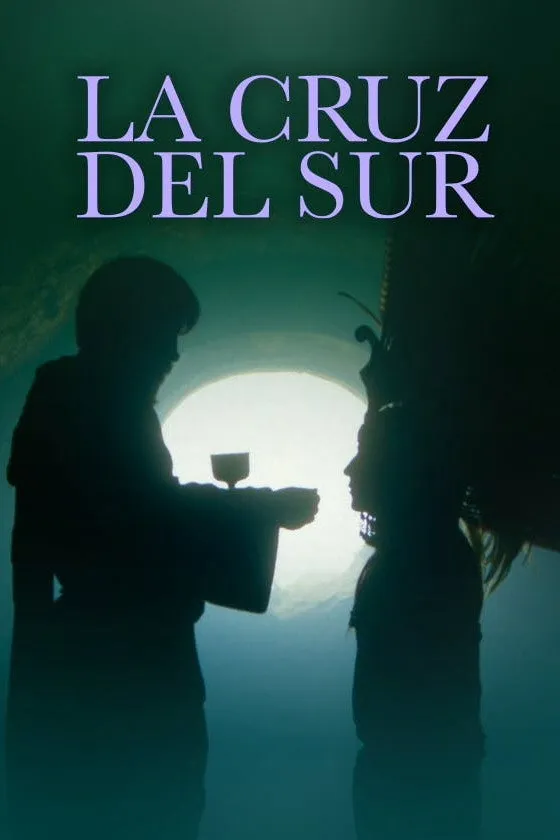
The Southern Cross (1992) is Patricio Guzmán’s documentary about religion in Latin America: pre-Columbian myths, the arrival of the conquistadors, syncretism and liberation theology. Its central subject is popular religion. Guzmán shot it in Mexico, Brazil, Ecuador, Guatemala and Peru for Spanish Television (TVE); the theatrical version runs 78 minutes.
About the film
The film spans five centuries. It begins with the myths of the cultures that preceded the conquest, continues with the arrival of the white man and the imposition of the Gospel, and ends with liberation theology, defended in the 1980s by theologians, bishops and priests in Brazil, Mexico, Peru, Ecuador and Guatemala.
At its center is popular religion. According to the film’s synopsis, in Spanish America it works as a sacred territory where millions of Indigenous people seek refuge; in Brazil, that role is played by religions of African origin, another territory that resists. He wanted to show, in his words, “the creativity of the indigenous, the mestizos and black people in relation to the Gospel.”
It came out in the middle of the 500th anniversary of 1492, with a very critical view of the conquest. Alongside the documentary footage there are reconstructed scenes, and in Venice Leonardo Autera wrote in the Corriere della Sera that the film alternated fiction and documentary in an exploration of the practices of Catholicism and its political use in South America.
The scholar Ignacio del Valle-Dávila considers it “the most ambitious project of his career” and notes that many of the “poetic” elements critics would later celebrate in Nostalgia for the Light and the films that followed were already present in works like this one. In an interview in the 1990s, Guzmán said that In the Name of God and The Southern Cross had helped him recover “a religious attitude toward life,” rooted in his Catholic upbringing as a child.
Making of
The idea grew out of his previous film. After making In the Name of God, Guzmán wrote, he became aware of the subversive thinking of part of the Catholic Church in Latin America in the 1980s: theologians, bishops and priests who held that “unless a country is liberated politically and socially there is no Christian salvation,” and who were sanctioned by John Paul II and the theologian Joseph Ratzinger. With them, he wanted to tell the history of the continent using faith as his guide.
It was produced by Quasar Films, of Madrid, for TVE, with Alicia Crespo as executive producer. Antonio Ríos shot the film, Walter Goulart recorded the sound and Marcelo Navarro edited it; Guzmán worked on the edit in Madrid. At the same time he prepared a three-part television version of 55-minute episodes, broadcast by ARTE and TVE Internacional.
Reception
In 1992 it won the Grand Prize of the Marseille festival, the Amiens award and the “Time of History” prize at the Valladolid film week; in 1994 it received the Spirit of Freedom award in Jerusalem. That same year, 1992, it was shown at the Venice Film Festival, and the 78-minute version was broadcast on television in a dozen countries, from Germany to Mexico and Brazil.
In Le Monde (July 12, 1992), Catherine Humblot praised its “slow, vast camera movements” and a reflection “at once baroque and austere.” Ángel Fernández Santos called it in El País “an intelligent, free and beautiful work of combat cinema,” and Eduardo Galeano, in a letter to Guzmán, “an accurate synthesis of fiction and document.”
Awards
- 1992Marseille International Documentary Film Festival — Grand Prize
- 1992Amiens International Film Festival — Grand Prize
- 1992Valladolid International Film Week — Time of History Award
- 1994Jerusalem Film Festival — Spirit of Freedom Award
Sources
- Patricio Guzmán, official website
- DOCMA
- Revista Primer Plano
- Patricio Guzmán, director’s notes and credits, official website (2016 and 2017 versions)
- CineChile, biography of Patricio Guzmán
- Memoria Chilena, “Patricio Guzmán en la sala de montaje de La cruz del sur en Madrid”
- Nostalgie de la lumière press kit, Pyramide, 2010
- Venice Film Festival 1992, Finestra sulle Immagini section (program on Wikipedia)
- Catherine Humblot, Le Monde, July 12, 1992; Ángel Fernández Santos, El País, September 10, 1992; Leonardo Autera, Corriere della Sera, September 9, 1992 (translations on the official website)
- Ignacio del Valle-Dávila, “Patricio Guzmán: el país de la memoria,” Primer Plano, September 24, 2026
- Interview with Patricio Guzmán (1990s), in Jorge Ruffinelli (2008), quoted in the teaching guide Patricio Guzmán, Chilean Ministry of Cultures, 2018