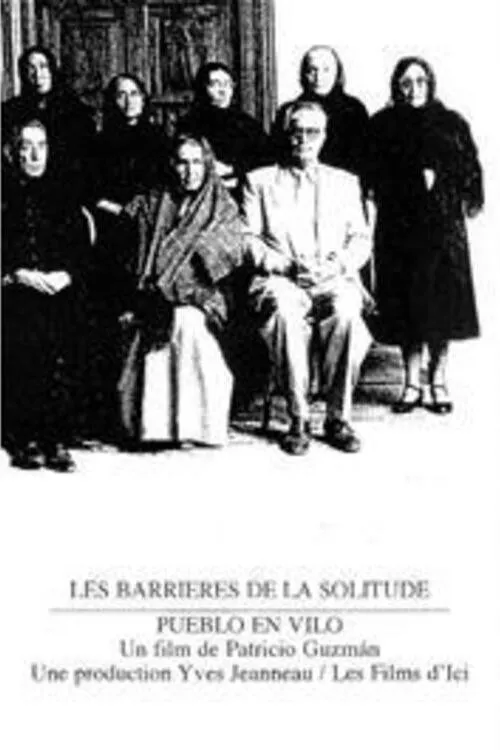
Pueblo en vilo (1995) is Patricio Guzmán’s documentary about San José de Gracia, a small town in Michoacán, Mexico, and about the book devoted to it by the historian Luis González y González, who was born there. Guzmán reconstructs the town’s scattered memory with González himself and other elders of the community. It was produced by Les Films d’Ici for France 2 and runs 52 minutes.
About the film
The film opens with the town band, the card players, the cemetery, the general store and the bell tower. Among the elders who remember is Bernardo González, the writer’s uncle and one of the town’s founders.
In the early 20th century, the townspeople saw a mysterious rain of ash fall and Halley’s Comet pass by, followed by a great aurora. There were treasure hunters and men who wanted to fly. The Mexican Revolution passed through its streets and, later, the Cristero War. The oldest residents strive to keep those memories; the youngest, to leave them behind.
It is a film with no direct connection to Chile, but the scholar Ignacio del Valle-Dávila sees it as a turning point in Guzmán’s work: for the first time he uses the first person, narrates in his own voice and makes memory the axis of the story. These are the traits of the films that would follow, starting with Chile, Obstinate Memory (1997).
Making of
Pueblo en vilo. Microhistoria de San José de Gracia (1968) tells the story of an unremarkable town: no railroad, no notable architecture, no crafts, no tourists. Its premise is that what happens in a small town echoes what happens in the whole country, and with it González founded microhistory in Mexico. “When I first read the book, I had the impression it was a fable similar to One Hundred Years of Solitude, but in a documentary key,” Guzmán wrote.
Eric Pittard shot the film, André Rigaud recorded the sound and Catherine Mabilat edited it; Renate Sachse was the artistic adviser and Yves Jeanneau the executive producer. In France it is known as Les Barrières de la solitude.
Reception
“For a remarkable book, a remarkable film,” wrote the critic Jorge Ruffinelli, who praised how Guzmán weaves together interviews, images of the town, archive footage and family photographs, far from the “futile folkloric view” of so many documentaries. Guzmán called it his least-known film, because it was barely distributed. In 2022 it was shown at MALBA, the Latin American art museum in Buenos Aires.
Sources
- MALBA
- Les Films d’Ici
- Revista Primer Plano
- Patricio Guzmán, director’s notes and credits, official website (2016 and 2017 versions)
- Jorge Ruffinelli, Nuevo Texto Crítico, Stanford University (quoted on the official website)
- CineChile, biography of Patricio Guzmán
- Ignacio del Valle-Dávila, “Patricio Guzmán: el país de la memoria,” Primer Plano, September 24, 2026