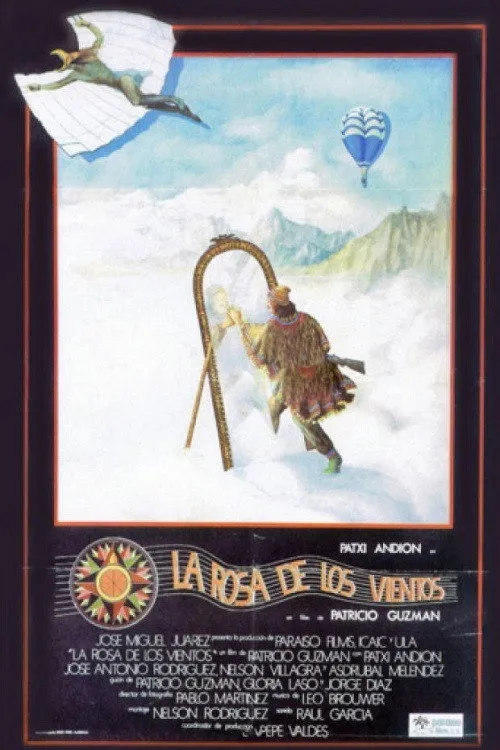
The Compass Rose (1983) is the only fiction feature Patricio Guzmán directed on his own: a fable about Latin America in which mythical beings and humans, conquistadors and Indigenous peoples, dreams and reality coexist. A coproduction of Spain, Cuba and Venezuela, it was shot in the Venezuelan Andes and the jungle, and premiered at the Directors’ Fortnight of the 1983 Cannes Film Festival. It runs 80 minutes.
About the film
The authorities of a Latin American country detect, high in the mountains, traces of unknown peoples and fear an outbreak of insurrection. They send Ronald Haller, a practical man with a Western mindset, played by Patxi Andión, to investigate. Haller cannot understand that world, much less Jorge Agrícola, a messianic leader who disappears and reappears. The deeper he goes into the jungle, the more he loses his sense of logic.
Guzmán described it as “the endless story of invasion and counter-invasion.” The invader is the government’s police apparatus; the invaded have neither weapons nor organization, but they slip through the cordon “because they see things differently.” “There is a culture that defends itself,” he said. The film brings together conquistadors, Indigenous peoples and supersonic jets in a single time, between dream and reality.
Alongside Andión, the cast includes Nelson Villagra, José Antonio Rodríguez, Héctor Noguera, the Chilean actress Gloria Laso and the Argentine Fernando Birri, one of the great names of New Latin American Cinema. For Guzmán, Andión gave here perhaps the best performance of his career.
In the following years, Guzmán worked mainly on series for Spanish Television, such as México precolombino, and returned to feature documentary with In the Name of God (1987).
Making of
The international success of The Battle of Chile opened the door to one of Guzmán’s great dreams: directing a fiction feature. It was produced by Spain’s Paraíso Films, the Cuban film institute ICAIC and the University of the Andes in Mérida, Venezuela. The screenplay is by Guzmán, Gloria Laso and Jorge Díaz, and the music by Leo Brouwer.
Much of the story takes place above the clouds, on the peaks of the state of Mérida. According to Guzmán, that was the easy part: in the jungle, the mosquitoes, the heat and the vegetation turned a shot with a horse into “a problem of strategy.” The film was edited in Havana, and that is where the trouble began. The Argentine filmmaker Fernando Birri, who acts in the film, told Jorge Ruffinelli that a senior ICAIC official objected that the film made no sense and wanted to turn it into a kind of thriller: “It is not the film Patricio dreamed, or raved about.”
Reception
The film was a critical and commercial failure. Ruffinelli wrote that it relied on allegory “as a genre,” with its most worn formulas, and that its mix of times would be far more convincing in The Southern Cross (1992). The critic Peter B. Schumann saw it as a “cinematic poem,” “at times somewhat forced,” within Latin American metaphorical cinema. In Spain, TVE-2 broadcast it on September 21, 1986.
Sources
- CineChile
- El País
- ENDAC
- Pedro Sorela, “TVE estrena el domingo una ‘inacabable historia de invasión y de contrainvasión’,” El País, September 18, 1986
- Jorge Ruffinelli, Patricio Guzmán, Cátedra / Filmoteca Española, 2001 (quoted in ENDAC)
- Film page, Foundation of New Latin American Cinema
- Ignacio del Valle-Dávila, “Patricio Guzmán: el país de la memoria,” Primer Plano, September 24, 2026
- Memoria Chilena, “Patricio Guzmán (1941-2026)”