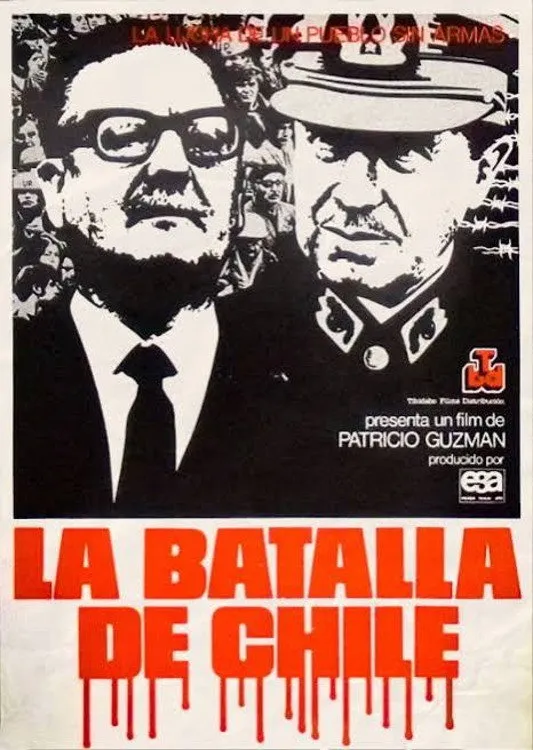
The Battle of Chile is Patricio Guzmán’s documentary trilogy about the final months of Salvador Allende’s government and the coup of September 11, 1973. Guzmán and a crew of five filmed in Santiago from October 1972 until the day of the coup; the film was edited in exile, in Cuba, and released in three parts between 1975 and 1979. Its total running time is 272 minutes.
About the film
In 1970 Salvador Allende won the presidential election with Popular Unity, an alliance of left-wing parties, and began a program of sweeping social and economic reforms. Two years later the country was divided. Guzmán, who had just finished The First Year about the government’s early days, put together a small independent crew to follow events step by step.
“It is a documentary made at the same time as the events were taking place,” he wrote. “It is not an archive film. Nor is it a compilation film.”
The shoot began on October 15, 1972, during the truckers’ strike, and ended on September 11, 1973. The crew filmed demonstrations, workers’ assemblies, sessions of Congress, Allende’s speeches and street conversations with supporters and opponents, in 16mm black and white.
The trilogy, whose full title is The Battle of Chile: The Struggle of an Unarmed People, is divided into three parts. The first two follow in order the events that led to the coup; the third returns to the same year from below, from the organizing of workers and neighbors.
I. The Insurrection of the Bourgeoisie (1975)
100 min · La insurrección de la burguesía
- 8.1IMDb · 2K votes
- 4.3Letterboxd · out of 5
- 8.2FilmAffinity · 1.8K votes
- 90 %Rotten Tomatoes · 10 reviews
Data as of November 23, 2026.
The first part covers the months from the March 1973 congressional elections, in which the Popular Unity parties won 43.4 percent of the vote, to early July. It follows the confrontation between the government and the opposition, the National Party and the Christian Democrats, in Congress, in the streets and in the factories: hoarding and shortages, strikes, interviews with supporters and opponents of Allende. Le Monde singled out the moment when the film shows, without hiding it, the copper miners’ strike against the government.
The part ends with footage shot by the Argentine cameraman Leonardo Henrichsen, who was filming for Swedish television on June 29, 1973, during the military uprising known as the Tanquetazo. A soldier aims at him and fires; it was his last shot. Henrichsen died that day.
II. The Coup d’État (1976)
90 min · El golpe de Estado
- 8.2IMDb · 1.6K votes
- 4.4Letterboxd · out of 5
- 8.1FilmAffinity · 1.4K votes
Data as of November 23, 2026.
The second part runs from March to September 1973. Left and right clash in the streets, in the factories, in the courts, in the universities, in Congress and in the press. There is a truckers’ strike, Allende tries and fails to reach an agreement with the Christian Democrats, the left argues over its own differences, and the military begins to conspire in Valparaíso.
In Le Monde, Louis Marcorelles singled out two moments: the funeral of Allende’s murdered naval aide and the huge demonstration of September 4, 1973, a week before the coup. The part ends on September 11, with the bombing of La Moneda presidential palace.
III. Popular Power (1979)
82 min · El poder popular
- 7.6IMDb · 1.3K votes
- 4.1Letterboxd · out of 5
- 7.9FilmAffinity · 1.2K votes
Data as of November 23, 2026.
The third part goes back and looks at what the first two left aside: the forms of organization that Allende’s own supporters created to cope with shortages and strikes, such as community stores, industrial belts and peasant committees. Guzmán described them as mostly spontaneous institutions, “a state within the State.”
Making of
The crew was small: Jorge Müller on camera, Bernardo Menz on sound, José Bartolomé as assistant director and Federico Elton as producer, with Guzmán as writer and director. They worked with a 16mm Éclair camera and a Nagra recorder. The French filmmaker Chris Marker, who had seen The First Year, sent them the black-and-white film stock, about 18 hours’ worth, and the sound tapes.
After the coup, Guzmán was held for fifteen days in the National Stadium, and most of the crew had to leave the country. The footage was saved thanks to the Swedish ambassador, Harald Edelstam: it traveled by ship to Stockholm and from there to Cuba. Jorge Müller was abducted by Pinochet’s secret police in November 1974 and remains disappeared; the film is dedicated to him.
The editing, with Pedro Chaskel, was done in a small room at the Cuban Institute of Cinematographic Art and Industry (ICAIC). In all, Guzmán said, the work took seven years: one of shooting and six of editing. The parts were released as they were finished.
Reception
The first part premiered in May 1975 at the Directors’ Fortnight of the Cannes Film Festival. Le Monde (May 21, 1975) wrote that it might remain “the first masterpiece of a new type of political analysis.”
The three parts won prizes in Grenoble, Leipzig, Brussels, Benalmádena and Havana, and the trilogy was released in theaters in more than thirty countries. In the United States, the first two parts opened at Film Forum in New York on January 12, 1978, distributed by the Tricontinental Film Center. In The New Yorker, Pauline Kael wrote that “aesthetically, this is a major film”; in The New York Times, Vincent Canby called it “undeniably an epic.” Cineaste magazine named it one of the ten best political films of 1967 to 1987.
In Chile it was not shown publicly until 1997, when Guzmán presented it at a Santiago theater during the first Fidocs festival. Chilean broadcast television aired it for the first time in September 2021, on the channel La Red, almost half a century after the coup. In 2023, for the 50th anniversary of the coup, Icarus Films brought a new 2K restoration to North American theaters.
Awards
- 1975Grenoble Film Festival — Grand Prize (Part I)
- 1975French Association of Film Critics — Novais Teixeira Prize (Part I)
- 1976Grenoble Film Festival — Grand Prize (Part II)
- 1976Leipzig Documentary Film Festival — Grand Prize of the International Jury (Part II)
- 1976Brussels International Film Meeting — Grand Prize (Part II)
- 1976Benalmádena Film Festival — Grand Prize (Parts I and II)
- 1977Benalmádena Film Festival — Grand Prize (Part III)
- 1979Leipzig Documentary Film Festival — Grand Prize of the International Jury (Part III)
- 1979Havana International Festival of New Latin American Cinema — Grand Prize (Part III)
Sources
- Memoria Chilena
- CineChile
- Patricio Guzmán, official website
- Le Monde, May 21, 1975, and Louis Marcorelles, Le Monde (English translation in the Icarus Films press kit)
- Pauline Kael, The New Yorker, January 23, 1978
- Vincent Canby, The New York Times, January 13, 1978
- Icarus Films, The Battle of Chile press kit (New York premiere and distribution history)
- Elsa Fernández-Santos, El País, May 1, 1997
- Samuel Brodsky, interview with Patricio Guzmán (Spanish translation in Bellas Letras, September 23, 2026)
- Radio Universidad de Chile, June 28, 2023
- Cinema Tropical, “New Restoration of Patricio Guzmán’s Landmark Doc The Battle of Chile to Have Theatrical Run,” 2023