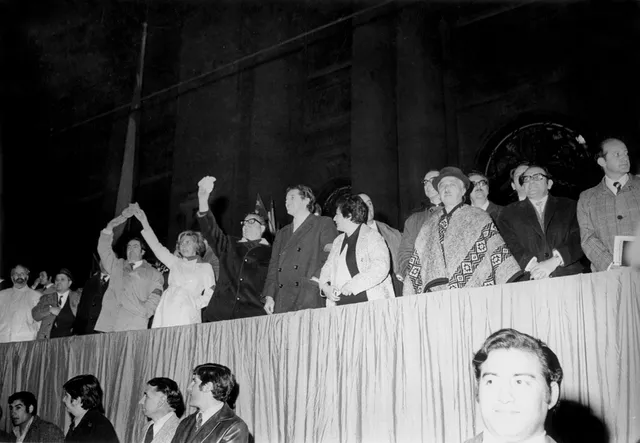
La respuesta de octubre (The Response of October, 1972) is a documentary by Patricio Guzmán about the employers’ strike of October 1972 against Salvador Allende’s government and about the response of the workers, who took over the factories in Santiago’s industrial belts. It was the first film he shot with the cameraman Jorge Müller. Today it no longer exists as a standalone work: Guzmán took it apart to build the third part of The Battle of Chile.
About the film
When the business owners stopped work to destabilize the government, they expected production to grind to a halt. The opposite happened: the workers kept the factories running and organized themselves by industrial district, the so-called cordones, or belts. Guzmán wanted to show other workers that this self-management was possible; the film was meant to be screened in factories and union halls with 16mm projectors. It was, in his words, “a very militant short, with intertitles,” ending with a huge demonstration on an avenue: for him, the birth of popular power.
Guzmán took the negative out of Chile in late 1973, along with the footage of The Battle of Chile. Five years later, in the editing room, he cut it into pieces: the whole opening sequence of Popular Power, the third part, which recounts the October strike, comes from this shoot. “La respuesta de octubre no longer exists,” he said in 2017. Even its running time is uncertain: CineChile lists 55 minutes, while Guzmán remembered about 40.
Making of
In 1972 Chile Films had commissioned Guzmán to make a fiction feature about the guerrilla fighter Manuel Rodríguez, with a script by Isidora Aguirre. With the strike, the state production company dropped the project for lack of funds, and before the crew scattered, Guzmán went out to film the stoppage with Jorge Müller on camera and Guillermo Cahn as assistant director. They filmed mainly in the Cerrillos and Vicuña Mackenna industrial belts, with a 16mm Arriflex and a Nagra recorder, handheld and in long takes.
Reception
In late February 1973 the film was shown to workers and discussed at a round table at the Catholic University’s School of Communication Arts, on the eve of the great rally of the industrial belts and community commands at the Teatro Caupolicán. “For us, La respuesta de octubre was a great political experience,” Guzmán said at the time. According to him, it won Chile Films’ “Mobile Circuits” award in late 1972.
Sources
- El Desconcierto
- CineChile, film page (based on Alicia Vega, Itinerario del cine documental chileno 1900-1990)
- Faride Zerán, “Encuentros con el Poder Popular,” March 9, 1973 (CineChile press archive)
- Interview with Patricio Guzmán, La tinta, May 24, 2017