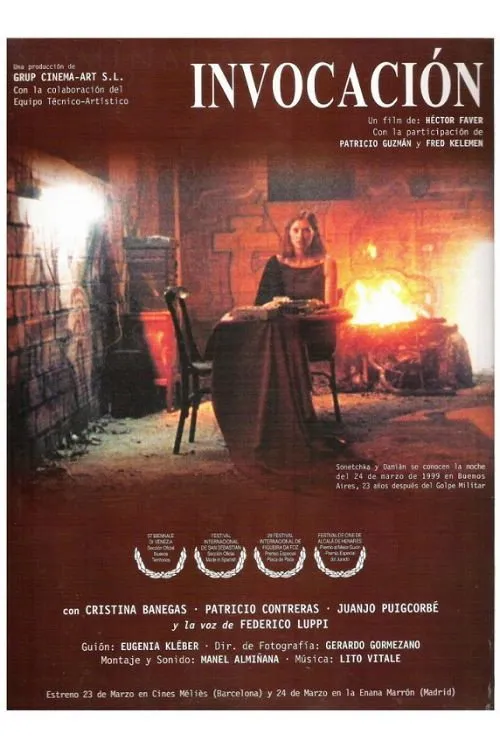
Invocación (2000) is a film by the Argentine director Héctor Faver, with the participation of Patricio Guzmán and the German filmmaker Fred Kelemen. It mixes fiction and documentary to connect episodes of Argentina’s recent history: the coup of March 24, 1976, the disappeared and the 1994 AMIA bombing. It was produced in Barcelona by Faver’s company, Grupo Cine Arte.
About the film
The film starts from a reconstruction: the shooting of a Super 8 action short that three twelve-year-old friends made in Buenos Aires in the spring of 1973, and which was later lost. From there it opens onto a wider journey through memory, beginning on the night of March 24, 1999, when Damián and Sonetchka, two circus performers of short stature, meet by chance in the streets of Buenos Aires, walk together and fall in love. Sonetchka is looking for her mother.
Alongside that story come the testimonies of the first Mothers of the Plaza de Mayo, who denounced that their children had been abducted, tortured and murdered, and who never found their grandchildren. In this way the film explores the relationship between disappearing and remembering, between forgetting and searching.
The cast includes Cristina Banegas, Patricio Contreras and Juanjo Puigcorbé, with the voice of Federico Luppi. The screenplay is by Eugenia Kléber, cofounder of Faver’s school, and the music by Lito Vitale.
In the credits, Guzmán and Kelemen appear “with the participation of” alongside Faver’s name; some databases list them as codirectors. The film does not appear in the filmography on Guzmán’s official website, and his contribution is limited to the sequences filmed with the Mothers of the Plaza de Mayo.
Making of
Faver, who lived in Barcelona, where he had founded the Centre for Film Studies of Catalonia, began shooting in Buenos Aires in July 1994. That month, the AMIA bombing killed two of his childhood friends, with whom he had first made films, and the project changed course. “Invocación is a broken fiction, a film I felt the need to open up, to make room for documentary,” he told Página/12.
For that documentary part he brought in two filmmaker friends from his school. Guzmán filmed the Mothers of the Plaza de Mayo in Buenos Aires, and Kelemen contributed from Europe. “They filmed sequences and gave them to me to include in my film,” Faver explained.
Reception
It opened in Buenos Aires in July 2000 and that year screened at the International Documentary Film Festival Amsterdam (IDFA). In Spain it reached theaters in March 2001. Cristina Banegas was nominated for the Silver Condor for best actress.
Sources
- Página/12
- IDFA
- ICAA film catalog
- Luciano Monteagudo, “El cine de Héctor Faver, un modo de volver a invocar los espectros,” Página/12, July 7, 2000
- Catalan Films, film page
- Spanish-language Wikipedia, “Invocación (película)”