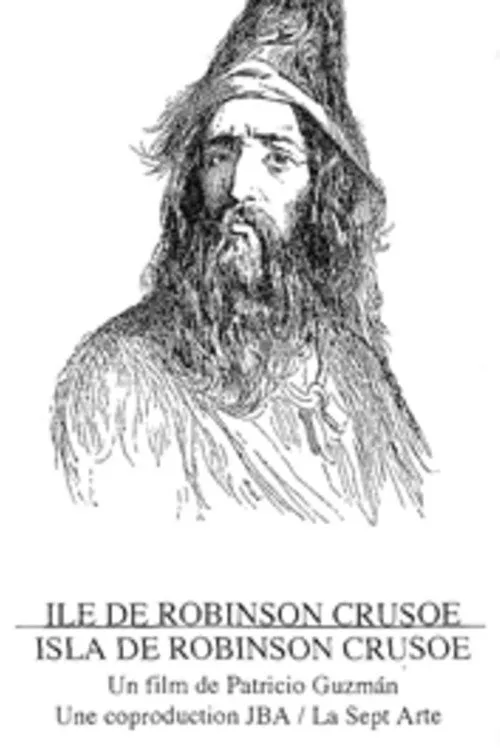
Isla de Robinson Crusoe (Robinson Crusoe Island, 1999) is Patricio Guzmán’s travel diary to the island in the Juan Fernández archipelago, in the Pacific Ocean, about 700 kilometers (435 miles) off the Chilean coast. The island of Daniel Defoe’s novel really exists, and Guzmán sets out to find the traces of Robinson, of Friday, of Defoe and of Pablo Neruda. It was produced by JBA Productions for ARTE and runs 42 minutes.
About the film
The island is real: in the early 18th century, the Scottish sailor Alexander Selkirk survived there completely alone for years, and his story inspired Defoe’s novel. Guzmán plays with that boundary. He talks about Selkirk as if he were Robinson and about the novel as if it had really happened, and searches the island for traces of the character: “Robinson’s cave is roughly the same size as a modern apartment,” he says in front of the ruins of an old settlement.
On the beach he wonders: “Twenty-eight years on this island is a long time, but why did Robinson tremble with fear and not with excitement when he saw the print of a bare foot on the beach?” Then he takes off his shoes and steps into a footprint in the sand. Friday’s footprint is now his own.
It is also a return to childhood, when he read adventure novels. “I am 13 again, and I feel nostalgia for the world as we dreamed it before we knew it,” his voice says. Between history, literature and imagination, the film becomes a travel diary with a gentle, ironic humor.
Making of
The film belongs to an ARTE series of first-person travel diaries: the director travels alone and films everything himself with a small digital camera. Guzmán handled direction, writing, camera and sound, with Álvaro Silva as assistant. He filmed in Valparaíso and on the island. Catherine Mabilat edited it and Jorge Arriagada wrote the music; Renate Sachse was the artistic adviser and Jacques Bidou the executive producer.
“Friday’s footprint on the beach is the only image from Defoe’s book that I truly remember,” Guzmán wrote. As a young man he found the castaway’s solitude terrible, and the thought that a man had spent twenty-eight years on an uninhabited island seemed almost impossible to him.
Reception
In a text the official website used to publish alongside the film, the critic Jorge Ruffinelli wrote that Guzmán represented “a new way of conceiving and practicing documentary,” free of the misconceptions of “objectivity and neutrality.” For the scholar Ignacio del Valle-Dávila, it forms, with Pueblo en vilo and My Jules Verne, a group of little-known films in which Guzmán starts from a book to reach a territory, and it anticipates the way he would later film the Atacama Desert and Patagonia.
Sources
- CineChile
- Film-documentaire.fr
- MALBA
- Patricio Guzmán, synopsis and credits, official website (2016 archive)
- Thérèse-Marie Deffontaines, “Sur Arte, les carnets de route de cinéastes-voyageurs,” Le Monde, July 30, 2000
- Catalog of the Festival International du Film Insulaire de Groix, 2019
- Jorge Ruffinelli (quoted on the official website)
- Ignacio del Valle-Dávila, “Patricio Guzmán, el filme-ensayo y las formas cinematográficas de la memoria,” Compós, 2024