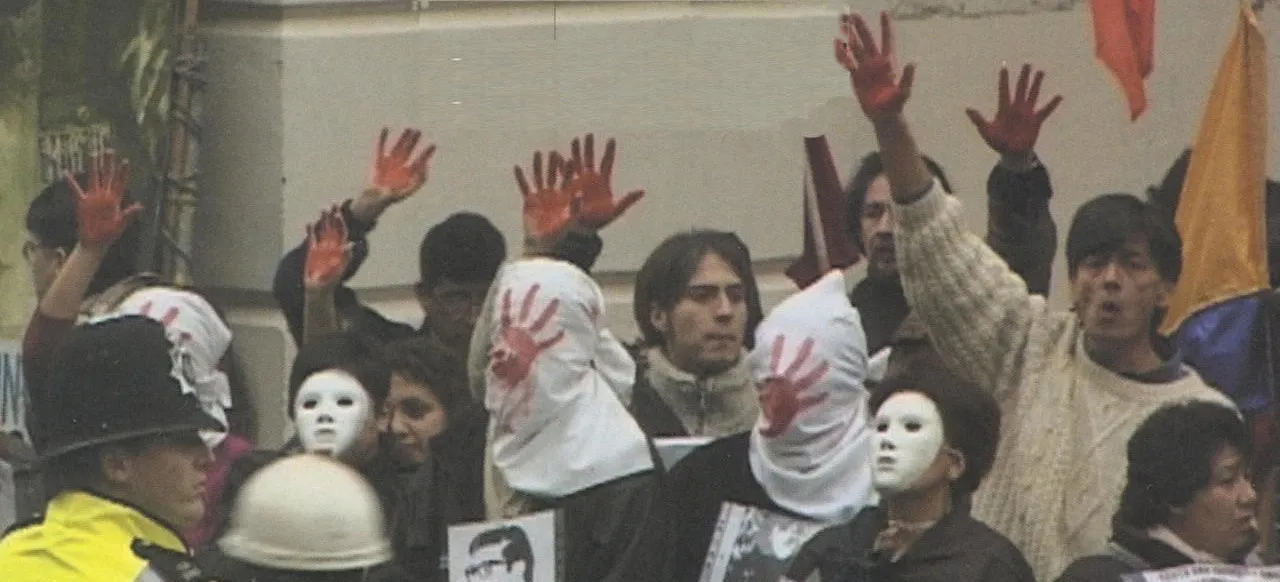
The Pinochet Case (2001) is Patricio Guzmán’s documentary about the arrest of Augusto Pinochet in London on October 16, 1998, on the orders of the Spanish judge Baltasar Garzón, and about the victims of the dictatorship who made the case possible. It premiered in May 2001 at the Critics’ Week of the Cannes Film Festival and runs 110 minutes.
- 7.3IMDb · 368 votes
- 3.6Letterboxd · out of 5
- 7.0FilmAffinity · 263 votes
- 94 %Rotten Tomatoes · 17 reviews
Data as of November 23, 2026.
About the film
In September 1998 Pinochet, then a senator for life, traveled to London. He had back surgery at a clinic, and when he woke up he was arrested on a warrant from Judge Baltasar Garzón, who accused him of genocide, terrorism and torture. He spent 503 days held in England, until on March 2, 2000, the British home secretary allowed him to return to Chile on health grounds.
The film shows how a very small group of people pushed the case forward: the prosecutor Carlos Castresana, the lawyers Joan Garcés, a former adviser to Allende, and Carlos Slepoy, and Judge Garzón. “This tiny group of people made possible something that had not happened since Nuremberg, which was to catch a dictator,” Guzmán said at Cannes.
It begins in the desert, where survivors and judges search for the remains of the disappeared. At its center are the victims, above all women who were tortured and who, for the first time in 25 years, are heard by a judge. In Chile, another judge, Juan Guzmán, continued the investigation.
Guzmán also gives the floor to those who defended Pinochet in London, among them his lawyer and a businessman friend who put him up in his house, and shows his meeting with Margaret Thatcher. “We wanted to make a credible film, even though it is a film against Pinochet,” he explained.
Making of
“When I heard on the radio that Pinochet had been arrested in London, I couldn’t believe it,” Guzmán wrote. He called the producer Yves Jeanneau, of Les Films d’Ici, and flew to London with his daughter Camila as his assistant and a small camera. There was no money, no written project, no budget. For months they kept filming in London, Madrid and Santiago, by then with a fuller crew.
Over three years of work, what struck the filmmaker most was filming the victims, most of them women. Ernesto Ekaizer, the El País journalist who followed the case closely, advised on the project. Jacques Bouquin shot the film, André Rigaut recorded the sound, and Claudio Martínez edited it, a process as long as the shoot.
Reception
At Cannes it received a moving ovation. The film won the Grand Prize of the Marseille festival in 2001 and the Golden Gate Award at the San Francisco festival in 2002. Ángel Fernández-Santos wrote in El País: “It is the work of a master of his craft.”
In Chile it opened on November 15, 2001. In Spain it was presented at the Zinebi festival in Bilbao and reached theaters on December 5 that year. In France, with 15 prints, about 60,000 people saw it.
In New York it opened at Film Forum in September 2002. The New York Times called it “a beautifully layered mosaic that is all the more powerful for never raising its voice to a shout.”
Awards
- 2001Marseille International Documentary Film Festival — Grand Prize
- 2002San Francisco International Film Festival — Golden Gate Award
Sources
- CineChile
- Memoria Chilena
- Página/12
- Patricio Guzmán, director’s notes, official website
- Isabel Camacho, El País, December 1, 2001
- Ángel Fernández-Santos, El País, 2001 (quoted on the official website)
- Cahiers du cinéma, no. 561, October 2001 (translation on the official website)
- Biarritz Latin America Film Festival, film page
- The New York Times, September 11 and October 3, 2002