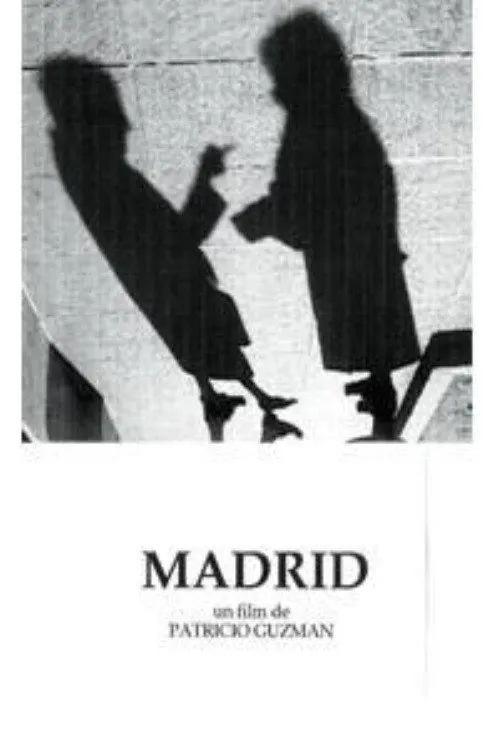
Madrid (2002) is Patricio Guzmán’s documentary about the Spanish capital, an intimate, sentimental walk through its streets, cafés, markets and people. Guzmán studied film in Madrid in the late 1960s and came back to live in Spain in the 1980s. It was produced by JBA Productions for ARTE, premiered in Chile at the 2002 FIDOCS and runs 41 minutes.
About the film
Six hundred meters (2,000 feet) up, in the middle of the Castilian plateau, rises a luminous city with an intensely blue sky, where the sun casts shadows that look as if they had been drawn in India ink. That is how Guzmán introduces it: a city with twenty kinds of rolls to go with your coffee, with a tavern every few steps for tapas, where people eat, drink, talk and some even dance flamenco.
Camera in hand, he wanders through El Rastro, the Sunday flea market, cafés full of arguments, the youth scene of the Movida and the elderly ladies, and looks for a small treasure hidden in the city. He recalls that beneath the streets of this modern city lie ruins from other centuries, and that its museums hold the best of Velázquez, Goya and Bosch.
It is a light gaze, but also a nostalgic one. For Guzmán, Madrid is one of the most cosmopolitan cities in Europe and, at the same time, a metropolis with the atmosphere of a provincial town.
Making of
“I chose to film in Madrid because I have a very personal relationship with the city where I lived for many years. It is like an old love,” Guzmán wrote. “With Madrid I have had a passion, a euphoria, later a falling-out, a forgetting and a new rapprochement, which has settled into a tender friendship.”
Guzmán handled direction, writing, camera and sound, with Andrea Guzmán as assistant. Claudio Martínez edited it, and the music is by Enrique Granados and Jorge Arriagada; Renate Sachse was the artistic adviser and Jacques Bidou the executive producer.
Reception
In France, the press praised it in December 2002. Le Monde wrote that it held “as many poetic images as magical moments,” and Télérama that Guzmán’s emotion was contagious. Les Inrockuptibles called “a stroke of genius” the café scene in which the director suddenly cuts the sound of a lively conversation, leaving only hands moving in the air.
In the United States it was distributed by Icarus Films. Casa de América in Madrid screened it in 2019.
Sources
- CineChile
- Casa de América
- L’Alternativa, Barcelona
- Patricio Guzmán, director’s note and synopsis, official website (2016 and 2017 archives)
- Le Monde, Télérama and Les Inrockuptibles, December 19, 2002 (translations on the official website)
- Memoria Chilena, “Patricio Guzmán (1941-2026)”