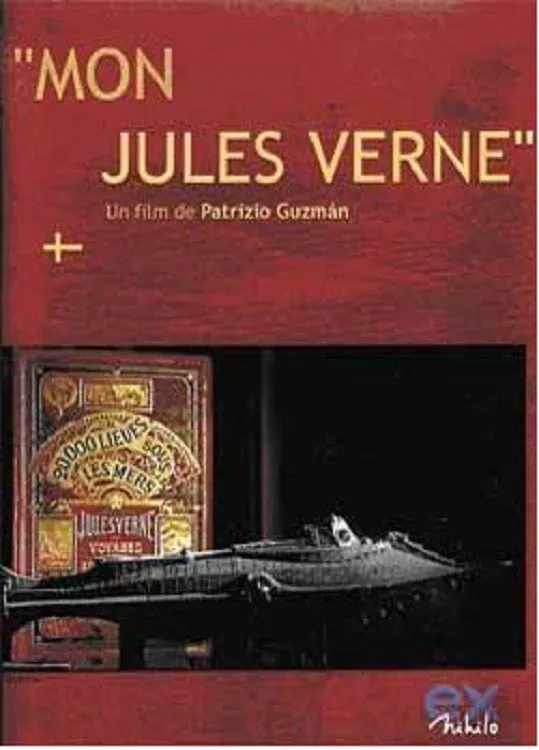
My Jules Verne (2005) is Patricio Guzmán’s documentary about Jules Verne and about the people who today make the journeys the writer imagined: an astronaut, a balloon pilot, a caver, a polar explorer. Guzmán tells it as a personal memory: that of “his” writer, who came into his life when he was ten. It was produced by Ex Nihilo for ARTE France and runs 58 minutes.
About the film
The film begins with a childhood story. At ten, Guzmán learned to travel “with his finger” over the maps lent to him by Carmen, his private tutor, and devoured the volumes of the Extraordinary Voyages. Verne, he recalls, was also a traveler of the imagination.
From there, the director takes us by balloon over the African jungle and aboard the Mir space station. We go into the sea with André Laban, a diver who paints underwater, just as Captain Nemo played music aboard the Nautilus, and into the darkness of the cave where Michel Siffre spent almost a year. The astronaut Jean-Pierre Haigneré, the astrophysicist Hubert Reeves, the explorer Laurence de la Ferrière and the pilot Michel Bergounioux also speak, as does the biographer Jean-Paul Dekiss.
At the end we arrive in Nantes, Verne’s hometown, where Jean-Luc Courcoult’s company Royal de Luxe built a twelve-meter (forty-foot) mechanical elephant that walks through the crowd: a tribute to The Steam House, an almost unknown novel, and to all the machines Verne invented, from flying ships to interplanetary rockets.
The film uses valuable archive material, such as images from the Czech director Karel Zeman’s Invention for Destruction (1958) and engravings from the first Hetzel editions. For del Valle-Dávila, the bond between literature and reality is an emotional one here: what matters is what Verne meant to each of the interviewees and to Guzmán himself.
Making of
“How to explain the meaning of Jules Verne’s adventure? Simply by looking for today’s explorers, who make the same journeys he imagined a century ago,” Guzmán wrote. For the trip to the Moon he filmed an astronaut who spent six months in space; for Five Weeks in a Balloon, a balloon pilot; for the polar voyages, a woman who crossed Antarctica alone, some 3,500 kilometers (2,200 miles); for Journey to the Center of the Earth, a caver who lived almost a year at the bottom of a cave.
Jacques Bouquin shot the film, André Rigaut recorded the sound, Eva Feigeles edited it and Jorge Arriagada wrote the music; Camila Guzmán was assistant director and Renate Sachse the artistic adviser. The executive producer was Dominique Barneau.
Reception
In December 2006, in Télérama, Marc Belpois called it “an amusing stroll that is at the same time a reflection, a contemplation. A beautiful tribute to Jules Verne.” In Les Inrockuptibles, Natalie Dray wrote that rather than make yet another biography, Guzmán had chosen to sketch a portrait of “his” Verne.
The scholar Ignacio del Valle-Dávila notes that the film presents childhood and adventure novels as an idealized territory, without questioning the colonial gaze of many of Verne’s books.
Sources
- Film-documentaire.fr
- MALBA
- FilmAffinity
- Patricio Guzmán, director’s notes and synopsis, official website (2017 archive)
- Marc Belpois, Télérama, December 18, 2006; Natalie Dray, Les Inrockuptibles, December 18, 2006 (translations on the official website)
- Ignacio del Valle-Dávila, “Patricio Guzmán, el filme-ensayo y las formas cinematográficas de la memoria,” Compós, 2024