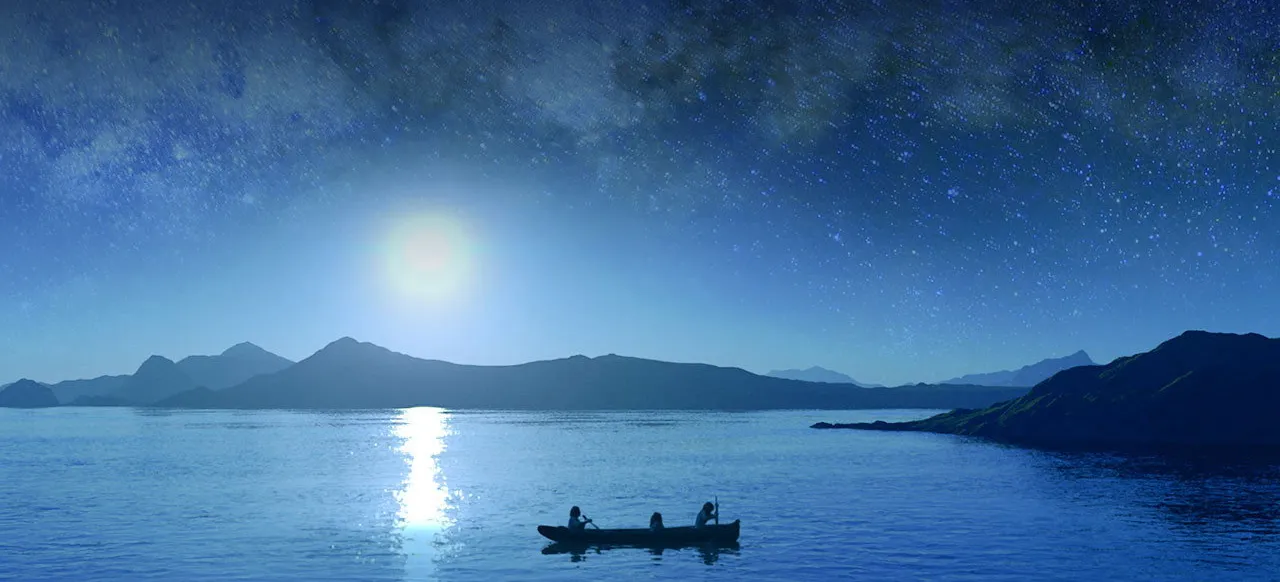
The Pearl Button (2015) is Patricio Guzmán’s documentary about water and the sea in Chile, linking the extermination of Patagonia’s Indigenous peoples with that of the political prisoners thrown into the ocean under the dictatorship. It premiered in the official competition of the Berlinale on February 8, 2015, where it won the Silver Bear for Best Script. It runs 82 minutes and is the second part of the trilogy Guzmán opened with Nostalgia for the Light (2010) and closed with The Cordillera of Dreams (2019).
- 7.6IMDb · 3.1K votes
- 3.9Letterboxd · out of 5
- 7.4FilmAffinity · 1.2K votes
- 93 %Rotten Tomatoes · 45 reviews
Data as of November 23, 2026.
About the film
Chile has one of the longest coastlines in the world and, in western Patagonia, a maze of islands and channels that has never been fully explored. Guzmán, who narrates the film himself, moves from the detail of a quartz stone or a drop of water to the far reaches of the universe: water exists in the solar system and beyond, and Chile’s observatories detect it in space. On Earth, the sea is the country’s longest border.
The peoples of the far south, the Kawésqar, Selk’nam, Aónikenk, Chono and Yagán, lived for thousands of years bound to the sea. Some of their last descendants speak in the film. Gabriela Paterito, a Kawésqar woman, traveled more than a thousand kilometers by canoe as a child and explains that her language has no words for God or for police. Cristina Calderón, a Yagán woman recognized in Chile as a Living Human Treasure, and her nephew Martín Calderón, who builds canoes like those of his ancestors, describe how their peoples lived.
The first button belongs to Jemmy Button. In the 19th century, a young Yagán agreed to travel to England on an English captain’s ship in exchange for pearl buttons, and the English gave him that name. He came back a year later, but he was no longer the same.
The second button was found on a length of rail recovered from the seabed. Under Pinochet’s dictatorship, the bodies of many political prisoners were tied to pieces of rail and thrown into the ocean; Guzmán estimates there were between 1,200 and 1,400. In the film, the journalist Javier Rebolledo explains how it was done.
The body of Marta Ugarte, which washed up on a beach in the Coquimbo region in September 1976, is the only one the sea gave back. “It seems to me that this woman was just like Jemmy Button; she represented the same thing,” Guzmán said.
Making of
Guzmán wanted to film Patagonia for years, but distance and lack of funding held him back. In 2011 he spent a week sailing the Strait of Magellan to see the places where the Kawésqar and the Selk’nam had lived, and in 2012 the project got under way, produced by Renate Sachse. The crew filmed aboard a sailboat belonging to Keri Lee Pashuk and Greg Landreth, sailors who know the region, and reached glaciers and mountain ranges that are very hard to access.
The idea for the title came from two objects. “At the Villa Grimaldi museum there is a piece of iron with a button embedded in it,” Guzmán told La Tercera. “I immediately saw a similarity between that button and Jemmy Button’s pearl button.”
Katell Djian shot the film, Emmanuelle Joly edited it, and the music is by José Miguel Miranda and José Miguel Tobar. The film also draws on the photographs Paz Errázuriz took of Kawésqar survivors in the 1990s and on the more than a thousand that Martin Gusinde took of the Selk’nam. It was produced by Atacama Productions, France 3, Mediapro and Valdivia Film.
Reception
In Berlin, besides the Silver Bear for Best Script, it received the Prize of the Ecumenical Jury. At the festival’s press conference, Guzmán said that a country without documentary cinema is like a family without a photo album. In 2016 it won the Lumière Award for best documentary in France and the Platino Award for best documentary.
In El País (February 11, 2016), Jordi Costa wrote that the film asks why the country with the longest coastline turns its back on the sea, and traced it to the denial of a collective guilt, or two: the colonial one and that of the dictatorship. He called it a “lucid, masterly work.”
In the United States, Kino Lorber opened it in New York on October 23, 2015, and The New York Times made it a Critic’s Pick. In the Los Angeles Times, Gary Goldstein found it “by turns lyrical, impressionistic and profound.” In Chile it was first shown at the Fidocs festival in September 2015 and reached theaters on October 15 that year.
Awards
- 2015Berlinale — Silver Bear for Best Script
- 2015Berlinale — Prize of the Ecumenical Jury
- 2015Fénix Awards — Best Documentary Cinematography
- 2016Lumière Awards — Best Documentary
- 2016Platino Awards — Best Documentary
Sources
- CineChile
- Berlinale
- La Tercera
- Patricio Guzmán, director’s notes, official website
- Matías Hinojosa, interview with Patricio Guzmán, La Tercera, September 26, 2015
- EFE, The Clinic, September 29, 2015
- Jordi Costa, El País, February 11, 2016
- The New York Times, October 23, 2015
- Gary Goldstein, Los Angeles Times, November 20, 2015
- Cinema Tropical, “Patricio Guzmán’s The Pearl Button Arrives in the U.S. This Fall,” 2015